The Future of Web Development: AI, Automation, Motion, and Human Creativity
Spread the love
Machines have learned to build faster than we can type — but they have not learned to care what gets built.
“Roughly four out of five development teams now ship code that an AI helped write. Almost none of them ship an idea an AI had.”
Introduction — The Rebalancing of a Craft
For thirty years, web development rewarded the same thing: fluency. Knowing the syntax by heart, remembering the flexbox quirk without looking it up, having built the pattern before — fluency was slow to earn and, precisely because of that, valuable. Then, over the span of roughly three years, a machine learned to be fluent for free. The result is the strangest, most productive, and most unsettled moment our craft has had since the browser wars.
AI did not arrive in web development as a single dramatic product launch. It arrived as a slow leak into every part of the pipeline — an autocomplete that finished a function, then a chat window that wrote the whole component, then an agent that opened the pull request, ran the tests, and quietly asked a human reviewer to take a look. Alongside it, automation matured in the background: continuous deployment became table stakes, visual regression testing became a checkbox instead of a manual chore, and infrastructure became a file sitting in the repo rather than a ticket sitting in a queue.
What changed is not that we build faster — we have always found ways to build faster. What changed is where the difficulty lives. When producing a plausible version of something becomes cheap, the scarce resource stops being production and becomes discernment: knowing which of the five plausible versions the machine handed you is actually the one worth shipping. That shift is why the future of web development looks less like a race toward full automation, and more like a rebalancing — the mechanical work drifting steadily toward machines, and the meaning-making work concentrating, more than ever, around people.
This piece is an attempt to map that rebalancing honestly. Not the marketing version, where AI quietly replaces every developer in the room. And not the defensive version, where nothing important has really changed. Somewhere in between is the working reality most teams are already living in — where AI writes the reducer, motion carries the story, automation clears the busywork, and a human still decides what deserves to exist at all.
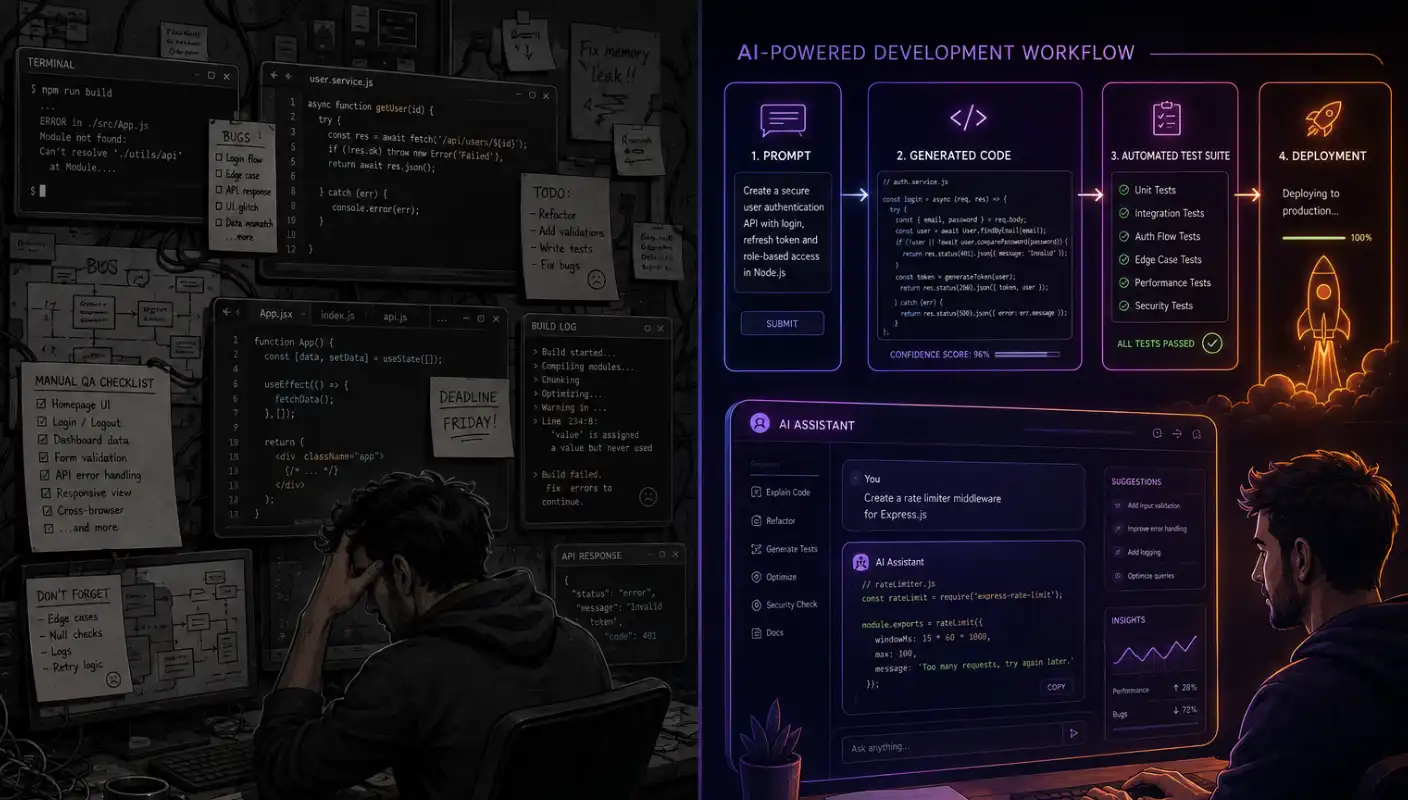
Old workflow versus AI-assisted workflow: the steps did not disappear, they were reordered around review rather than production.
AI as a Development Partner, Not a Replacement
The most useful way to think about an AI assistant is not as a junior developer, but as an extremely well-read stranger who has never met your users. It has seen every pattern and none of your context. That framing explains both its brilliance and its failures.
Code generation is where the change is most visible. Tools like GitHub Copilot, Cursor and Claude Code now handle the tedious middle of a task: the reducer, the Zod schema, the fifteen unit tests you know you should write. On a recent build, a two-person team at a mid-sized agency scaffolded an entire design-token pipeline in an afternoon — work that a year earlier would have been a week of quiet, unglamorous typing. The value was not the saved days. It was that the interesting decisions arrived on day one instead of day six.
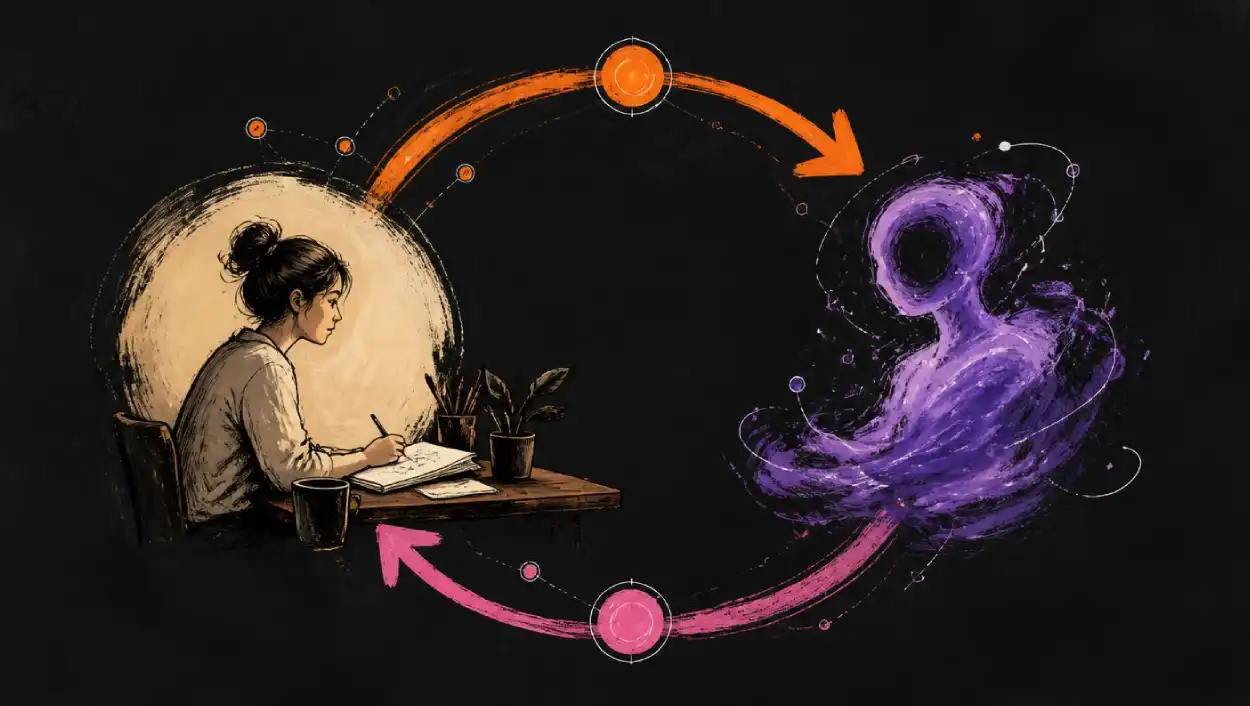
The collaboration loop: human intent, machine draft, human judgement, machine refinement. The loop only works if someone owns the last step.
Automated testing and debugging has moved further than most people notice. Models are unusually good at reading a stack trace and proposing the three most likely causes, and even better at generating the edge cases a tired human forgets: empty arrays, expired tokens, right-to-left text, the user who double-clicks. Paired with a runner that executes on every commit, this has turned test coverage from an aspiration into a default.
Design-to-code is the newest and messiest frontier. Handing a Figma frame to a model and receiving structured components back is genuinely possible now. What still requires a person is everything the frame does not say: how it behaves at 320 pixels, what happens while data loads, which element deserves focus first, and whether the spacing rhythm survives real content.
The teams getting the most from this are not the ones generating the most code. They are the ones who tightened their review loop first — strong types, fast tests, clear conventions — so that generated work lands in a system that can catch it. The GitHub engineering blog documents this pattern repeatedly: the constraint is never generation speed, it is review throughput.
Focusing only on code generation understates what has happened. The larger story of web development automation is that the distance between an idea and a live URL has collapsed — and most of that collapse had nothing to do with AI at all.
Automated QA now covers ground that used to be checked by feel. Accessibility linters catch missing labels before review. Visual regression tools screenshot every component across breakpoints and flag the three-pixel shift nobody would have noticed until a client did. Performance budgets fail the build when a careless dependency adds 200KB.
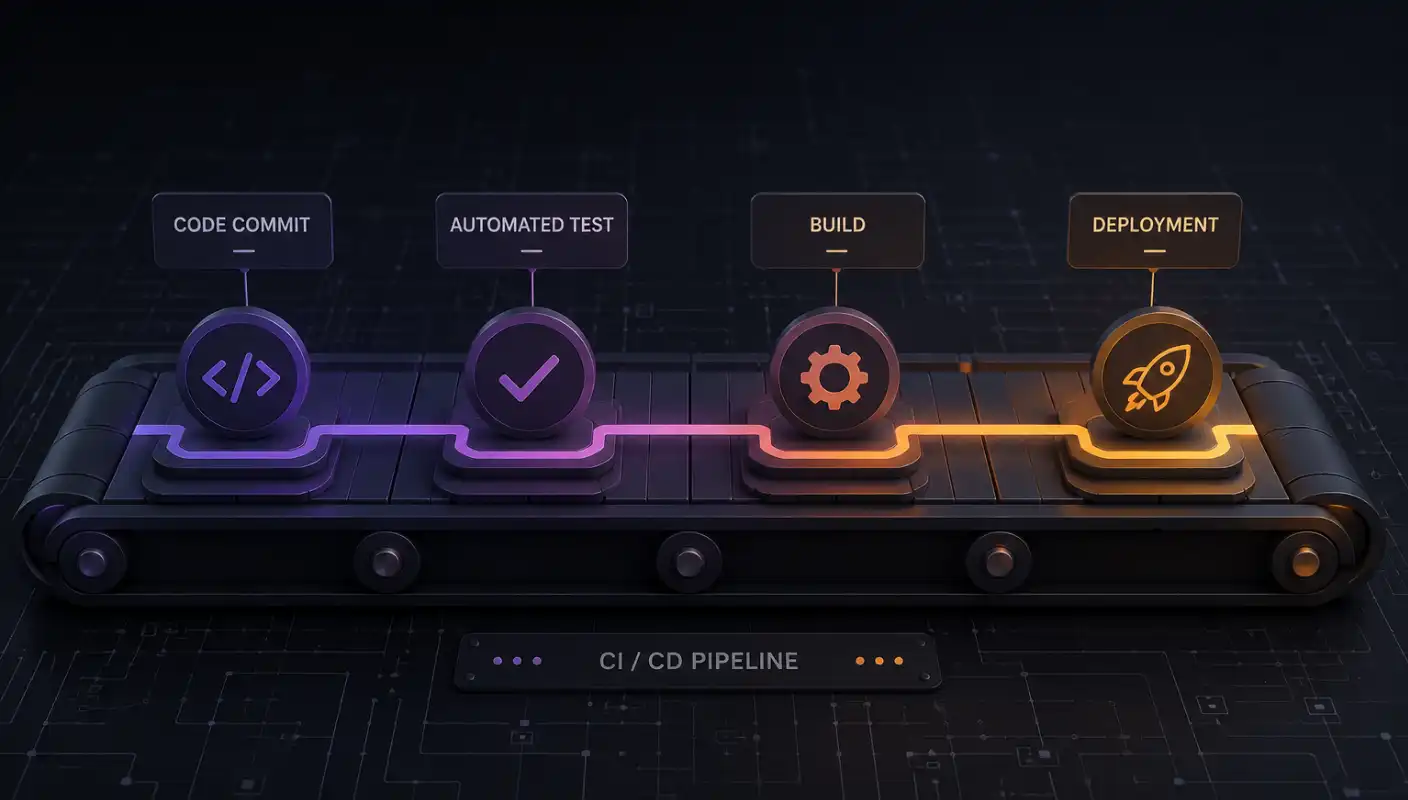
CI/CD pipelines turned deployment from an event into a non-event. Preview deployments per pull request — popularised by platforms documented on the Vercel blog — changed the social dynamics of a project as much as the technical ones. A stakeholder clicking a working link gives better feedback than the same stakeholder reading a status update.
Auto-generated documentation is the quiet win. Types become API references, commits become changelogs, and component libraries document themselves. Documentation stopped being a project and became a byproduct.
No-code and low-code tools absorbed the bottom of the market — and that is healthy. A local restaurant does not need a custom build, and pretending otherwise was never good advice. What remains for engineering teams is the work that is genuinely hard: unusual data models, real performance constraints, integrations that must not fail, and interfaces that need to feel like something rather than merely function. See how we scope that on our automation and engineering page.
The collaboration loop: human intent, machine draft, human judgement, machine refinement. The loop only works if someone owns the last step.
The risk in all of this is homogeneity. Automation optimises for the known-good answer, and the known-good answer is by definition the one everyone else already shipped. A pipeline that removes every rough edge also removes the edges that made the work recognisable.
Automation adoption across product teams (illustrative)
Practice
2021
2026
Reported time saved
AI code assistance
8%
81%
~26%
Automated CI/CD
47%
89%
~18%
Visual regression testing
12%
54%
~11%
Generated documentation
9%
48%
~14%
Low-code for internal tools
21%
63%
~30%
Figures are illustrative composites used to show direction of travel, not survey data.
Motion & Interaction as a Core Skill
When everyone can produce a competent static page in an afternoon, a competent static page stops being an achievement. This is the quiet reason motion has moved from decoration to core craft: it is one of the few remaining places where care is immediately legible.
Motion is not animation for its own sake. It is the grammar of state. A list that reorders with a transition tells you what moved. A button that acknowledges a press in 80 milliseconds tells you the system heard you. A modal that grows from the element that spawned it tells you where you are and how to get back. Strip that grammar out and an interface becomes a series of unrelated screenshots.
WebGL and Three.js have become approachable enough that real-time three-dimensional scenes now appear on product pages rather than only in award showcases. The discipline is in restraint: a 12MB scene that delays interaction by four seconds is not craft, it is a tax on the visitor.
Scroll storytelling matured past the era of hijacked scrolling. The good version treats scroll as a timeline the reader controls, revealing information at the pace of their attention rather than performing at them.
AI-generated animation assets are the newest addition — interpolated frames, generated easing curves, sprite sequences produced from a text description. They are excellent at producing motion and indifferent to whether that motion means anything. Choreography, timing, and knowing when the right amount of animation is none: still ours.
“Anyone can add motion. The craft is deciding what should stay still.”
Why Human Creativity Still Leads
Every argument about AI and human creativity eventually reaches the same test: can the machine decide what is worth doing? So far, reliably, no. It can generate a hundred directions and rank them by resemblance to what already exists. It cannot want one of them.
Strategic thinking is the first thing that stays. Choosing to remove three features so the fourth becomes obvious. Deciding that the homepage should not have a hero at all. These decisions come from understanding a business’s actual constraints, and they are usually unpopular before they are correct.
Brand storytelling is the second. A brand voice is a set of accumulated choices with a point of view — including the awkward ones. Generated copy converges toward the statistical middle of everything ever written, which is precisely where no memorable brand lives.
Ethical judgement is the third, and it is growing more important as generation gets cheaper. Whether a pattern is persuasive or manipulative, whether a data request is necessary or extractive, whether an interface treats a distracted person fairly — these are moral questions wearing UI clothing. Ongoing coverage in MIT Technology Review makes a consistent case that automated systems inherit the values of whoever declined to think about them.
Taste is the last and least explainable. It is the ability to look at six good options and feel that the fifth is the one. Taste is built from being wrong in public, absorbing things outside your field, and caring about details that no metric rewards. A model can imitate the output of taste. It cannot hold the responsibility that produces it. That is why, in every project we take on at emavens, the machine drafts and a person decides.
The part of the process that has not been automated: wanting the work to be good.
“Automate production. Never automate the decision about what deserves to be produced. That distinction is the whole job now. ”
No — but it is redrawing the job description. AI in web development is very good at the mechanical middle of the work: scaffolding, translating a design token into CSS, writing the tenth variation of a form validator. It is far weaker at deciding what should be built, why a flow feels wrong, or how a brand should sound. The developers who thrive treat generation as a first draft they are responsible for editing.
It varies wildly by team, but on projects using assistants heavily, a meaningful share of boilerplate, tests and type definitions now begins as a suggestion. The number matters less than the review discipline around it — accepted code you do not understand is technical debt with a shorter fuse than usual.
Increasingly, yes. Interaction and motion are how a page communicates state, hierarchy and personality. You do not need to be a Three.js specialist, but understanding easing, choreography and restraint has moved from a nice-to-have into the core craft of the future of web design.
Start where the pain repeats. Continuous deployment on every merge, automated accessibility and visual regression checks, and generated API documentation usually pay for themselves inside a quarter. Automate the boring path to production first; leave judgement-heavy work to people.
The rebalance, not the replacement
The future of web development is not a story about machines taking over. It is a story about the centre of gravity moving — away from production and toward judgement. Teams that understand this are not slower for using AI, and they are not interchangeable because of it. They simply spend their scarce hours on the parts that still require a person.
AI in web development compresses production; it does not compress responsibility.
Web development automation pays off fastest where the work repeats — CI/CD, QA, docs.
Motion and interaction are now craft skills, not garnish.
AI and human creativity are complements: one drafts, one decides.
The future of web design belongs to teams with a point of view worth automating toward.