AI has quietly rewritten the daily job of a performance marketer. Campaign setup that took days now takes an hour, bids move thousands of times a day, and reporting arrives as recommendations rather than raw rows. Here is what genuinely changed — and what still depends entirely on you.
Introduction
Performance marketing began as a spreadsheet discipline. You built keyword lists by hand, wrote three ad variants, set a manual CPC, and came back on Monday to see what survived the weekend. The channel mix changed over the years — search, social, programmatic display, retail media — but the operating model stayed the same: humans made thousands of small decisions, slowly, using yesterday’s data. That model broke for a simple reason. The number of decisions grew faster than teams could hire.
A single mid-market advertiser today runs across five or six platforms, dozens of audiences, hundreds of creative variants and a bid landscape that reprices every few seconds.
No human team can evaluate that surface area with any consistency, and the cost of being slow is measured in wasted spend. This is where AI in performance marketing stopped being a talking point and became plumbing. Every major ad platform now runs machine-learned auctions, predictive audience expansion and generative creative assembly by default. Advertising spend managed by automated bidding already accounts for the majority of paid search budgets, and Gartner’s marketing research consistently shows AI moving from experimental line item to core operating budget.
Adoption matters now because the advantage is compounding rather than absolute. Everyone gets the same models; the difference is the quality of what you feed them — conversion signal, margin data, creative volume and clean account structure. Advertisers who fixed their measurement in 2024 are the ones whose AI ad campaigns are outperforming in 2026.
Those still passing last-click revenue into a target-ROAS bid strategy are getting confidently optimised toward the wrong outcome. If you are new to the mechanics, start with the fundamentals — as covered in our guide to performance marketing basics— and then return here. The rest of this article walks through the four places AI genuinely changes output: setup speed, bidding, data interpretation and continuous optimization, followed by the parts of the job it does not touch.
Modern performance stacks surface recommendations, not just reports.
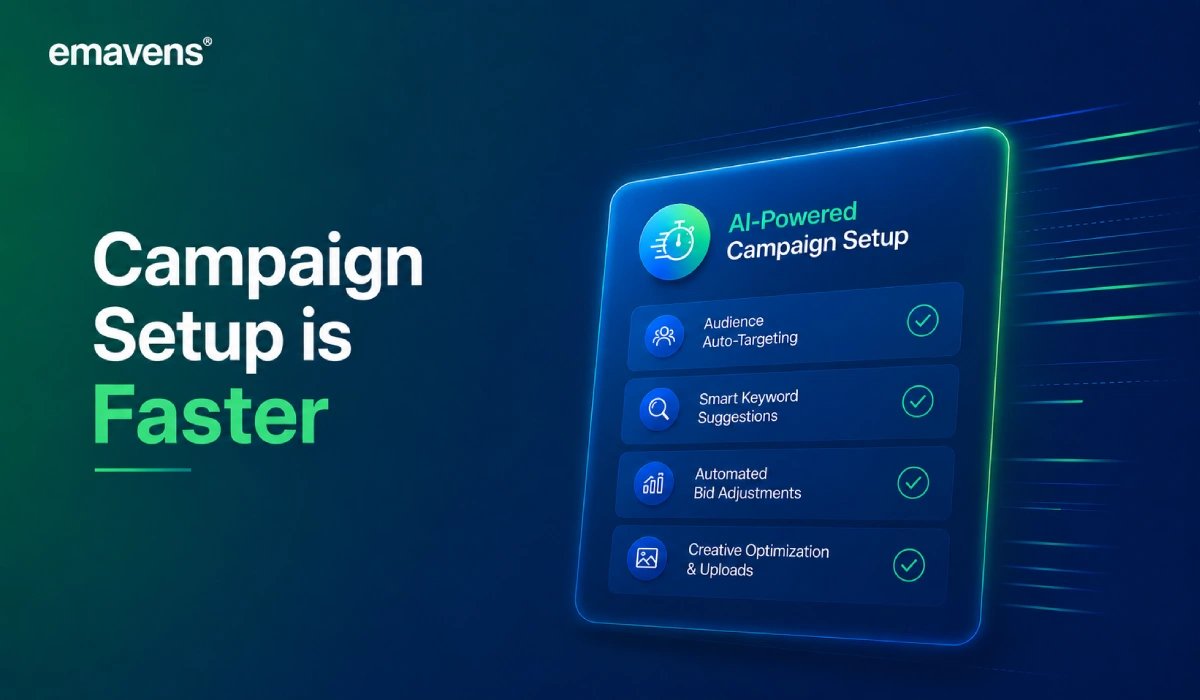
Campaign Setup is Faster
The most immediate, least glamorous impact of AI is time. Launch workflows that consumed two or three days of a specialist’s week now compress into a focused afternoon. That difference is not just efficiency — it changes how many hypotheses a team can test per quarter, which is the real driver of performance.
Audience auto-targeting and smart keyword suggestions
Instead of hand-building interest stacks, you describe the customer and the model proposes seed audiences, lookalike expansions and exclusion sets drawn from historic converter behaviour. On search, keyword planning tools now cluster intent automatically: transactional, comparison and research queries get separated before you write a single ad. Teams routinely report cutting keyword research time by half while surfacing long-tail terms manual planning misses entirely.
Automated bid adjustments and creative uploads
Bid modifiers by device, geography, daypart and audience used to be a spreadsheet ritual. They are now inferred from the conversion model at auction time. In parallel, generative creative pipelines resize, re-caption and version assets across every placement spec, so a single master creative becomes a full set of compliant variants in minutes rather than a designer's afternoon. Our breakdown of AI ad creative tools covers which of these hold up in production.
A practical example: A mid-size D2C skincare brand we worked with previously took nine working days to launch a seasonal campaign across search, Meta and YouTube. With AI-assisted keyword clustering, automated asset versioning and templated conversion tracking, the same launch shipped in two days — and because launch happened eleven days earlier, it captured the front half of the demand curve instead of the tail.
AI-assisted setup: checklists, auto-generated variants and pre-filled targeting.
Quick Tip
Build one canonical naming convention before you automate anything. Generative tools multiply assets fast, and an account with 400 auto-named creatives is unreadable by week three. Encode campaign, audience, offer and variant in every asset name — future you will be able to run a clean creative analysis in ten minutes instead of a day.
Takeaway: speed of setup buys you more experiments per quarter, and experiment volume is what compounds.
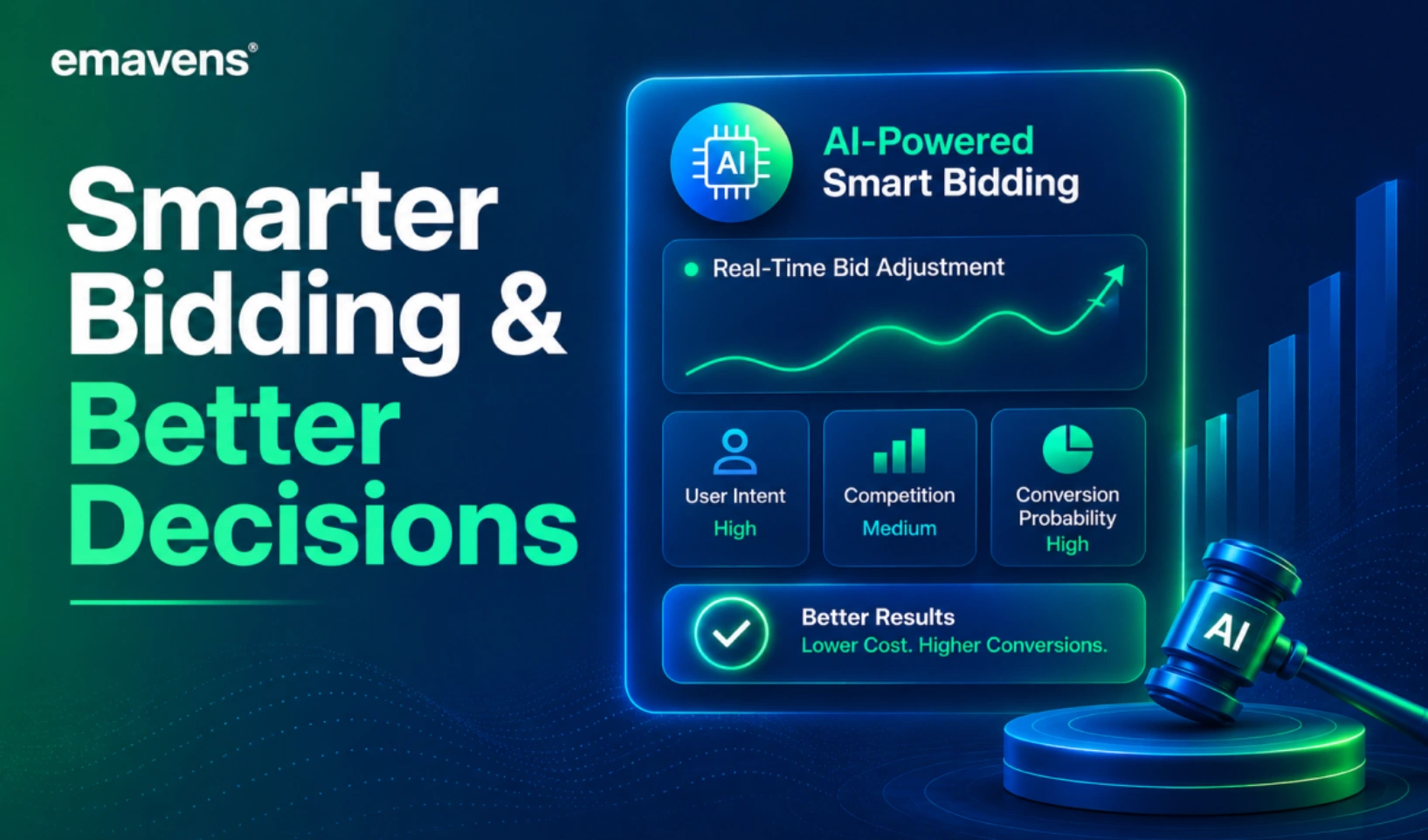
Smarter Bidding & Better Decisions
Bidding is where automated bidding models create the widest gap between machine and human capability. A manual bid is a static guess about the average value of a click. A model bids on the specific, individual auction in front of it, using signals no spreadsheet can hold.
Real-time adjustment and user intent
Modern systems evaluate query wording, device, time of day, browsing recency, geography, historical conversion path and hundreds of latent signals — then reprice the bid per impression. Two people searching the same keyword can receive bids that differ by 300% because one shows purchase intent and the other is researching. That granularity is simply not reachable manually.
Competition tracking and conversion probability scoring
Models continuously read auction pressure — who is bidding, when they enter, how aggressively — and back off in slots where marginal cost exceeds expected value. Each impression carries a conversion probability score, and the bid is a direct function of that score multiplied by expected order value. This is why AI marketing optimization tends to improve efficiency before it improves volume: the first thing it does is stop paying full price for low-probability traffic.
Every impression is priced individually against a predicted conversion value.
Traditional SEO vs AI SEO
Factor
Traditional SEO
AI SEO
Keyword Research
Manual research & analysis
AI discovers trends instantly
Content Creation
Time-consuming writing
AI-assisted, faster production
Optimization
Periodic updates
Continuous optimization
Performance Tracking
Manual reporting
Real-time insights & predictions
Scalability
Limited by team capacity
Handles thousands of pages easily
Note
AI bidding optimises toward the goal you set, not the goal you meant. If your conversion action is a newsletter signup, the model will happily buy cheap signups forever. Humans remain responsible for choosing the objective, feeding real margin values, setting guardrails and deciding when a campaign should be paused rather than improved.
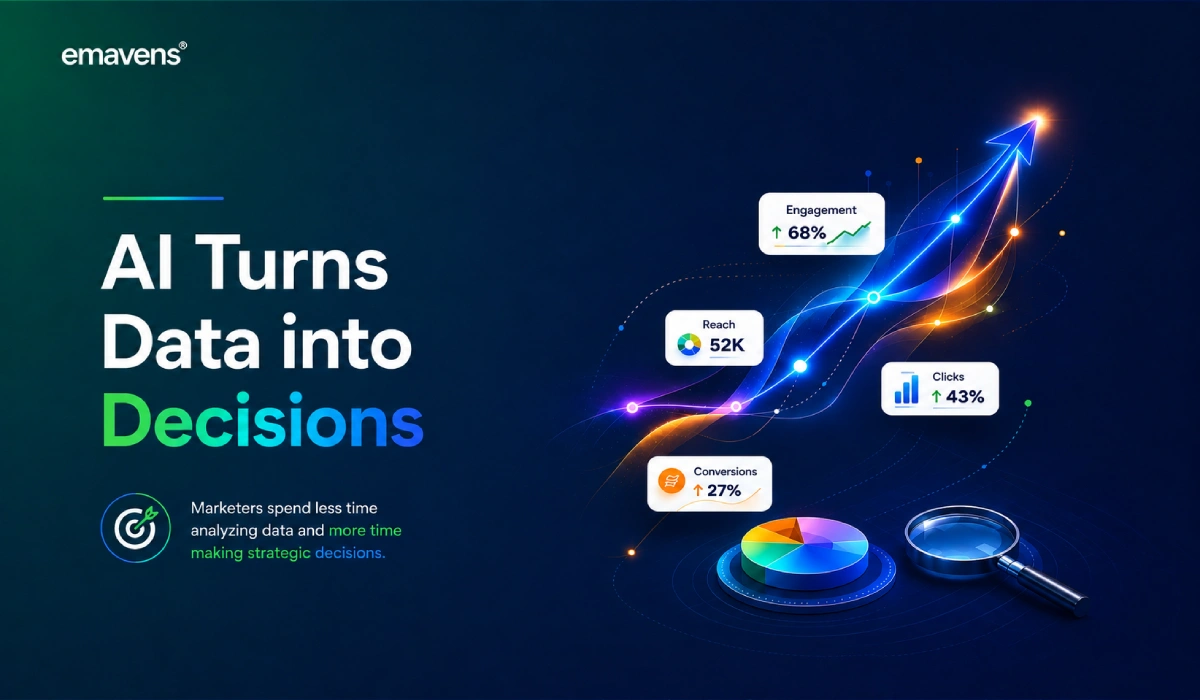
AI Turns Data into Decisions
Reporting used to end where the work began: you exported the data, then spent hours deciding what it meant. AI collapses that gap by delivering interpretation alongside the numbers — patterns, forecasts and ranked recommendations instead of raw rows.
+68%
Engagement lift
52.0K
Reach (accounts)
+43%
Click growth
+27%
Conversion uplift
Uncover trends and predict performance
Anomaly detection flags a CPA drift on day two instead of at month-end review. Seasonality models separate genuine demand shifts from noise, so you stop over-reacting to a bad Tuesday. Forecasting projects where a campaign lands at current trajectory, which turns budget conversations from opinion into arithmetic.
Recommend optimizations and drive better decisions
The most useful systems rank actions by expected impact: shift 15% of budget from prospecting to mid-funnel retargeting, retire three fatigued creatives, expand two audiences approaching saturation. Marketers approve or reject; the model learns from the decision. Industry benchmarks published by HubSpot's marketing statistics research consistently show teams using AI-assisted analysis reporting materially higher campaign efficiency than those relying on manual reporting cycles.
AI turns complex data into smarter decisions, helping marketers optimize campaigns, boost conversions, and drive better results.
Sample Results: 60 Days Before vs After AI Implementation
Metric
Before AI
After AI
% Change
Engagement Rate
2.4%
4.0%
+68%
Monthly Reach
34,200
52,000
+52%
Clicks
8,900
12,730
+43%
Conversions
412
523
+27%
Cost per Acquisition
$41.60
$31.80
−24%
We’re your Shopify partner, your CTO, your Designer, your Developer, your Digital Marketing team — whatever you need, we’re just a click away.” — eMavens”
Better Optimization
Optimization used to be a weekly event. Someone opened the account, looked at seven days of data, and made a judgement call. Everything between those reviews ran unattended. Continuous optimization removes that dead time entirely.
Less guesswork, better ROI
Bids, budgets and placements are adjusted continuously against live conversion probability. Underperforming placements are throttled within hours rather than at the next review. Budget flows toward the campaigns currently converting, not the ones that converted last month. The compounding effect is significant: small daily corrections across a 60-day flight typically outperform four large manual interventions.
AI-powered optimization adjusts bids, budgets & placements to maximize conversions.
Continuous bid, budget and placement adjustment
A mid-size e-commerce brand using AI bid optimization saw a 27% increase in conversions within 60 days at flat spend — driven almost entirely by reallocating budget away from three placements that looked acceptable on averages but were losing money at the margin. No new creative, no new audience, just faster correction.
Campaigns under continuous AI optimization corrected underperforming placements in under 6 hours — against a 5-day average for weekly manual review cycles.
— emavens Growth Team benchmark, 2026
AI Doesn't Replace Marketers
Every capability described above improves execution. None of them decide what is worth executing. AI is exceptional at optimising toward a defined objective and completely indifferent to whether that objective is the right one — which is precisely the part of the job that determines whether a business grows.
Strategy
Which market, which offer, which margin to defend, and when to stop spending altogether.
Creativity
Insight, positioning and the uncomfortable idea a model would never generate from historic data.
Business Decisions
Brand risk, pricing, channel bets and tradeoffs that live outside the ad account entirely.
In practice, the highest-performing teams we work with have not shrunk — they have re-shaped. Fewer hours on bid edits and asset resizing; more hours on offer testing, landing page quality, measurement integrity and creative concepting. The model handles volume; the marketer handles meaning. Our write-up on human + AI marketing teams details the roles and review rituals that make this split work.
Key Takeaway
Treat AI as your fastest junior operator, not your strategist. It executes at a scale no team can match, and it will pursue a badly chosen goal with the same enthusiasm as a good one. Keep humans on objectives, values and creative direction — automate everything downstream of those decisions.
Audience Targeting Has Become Smarter
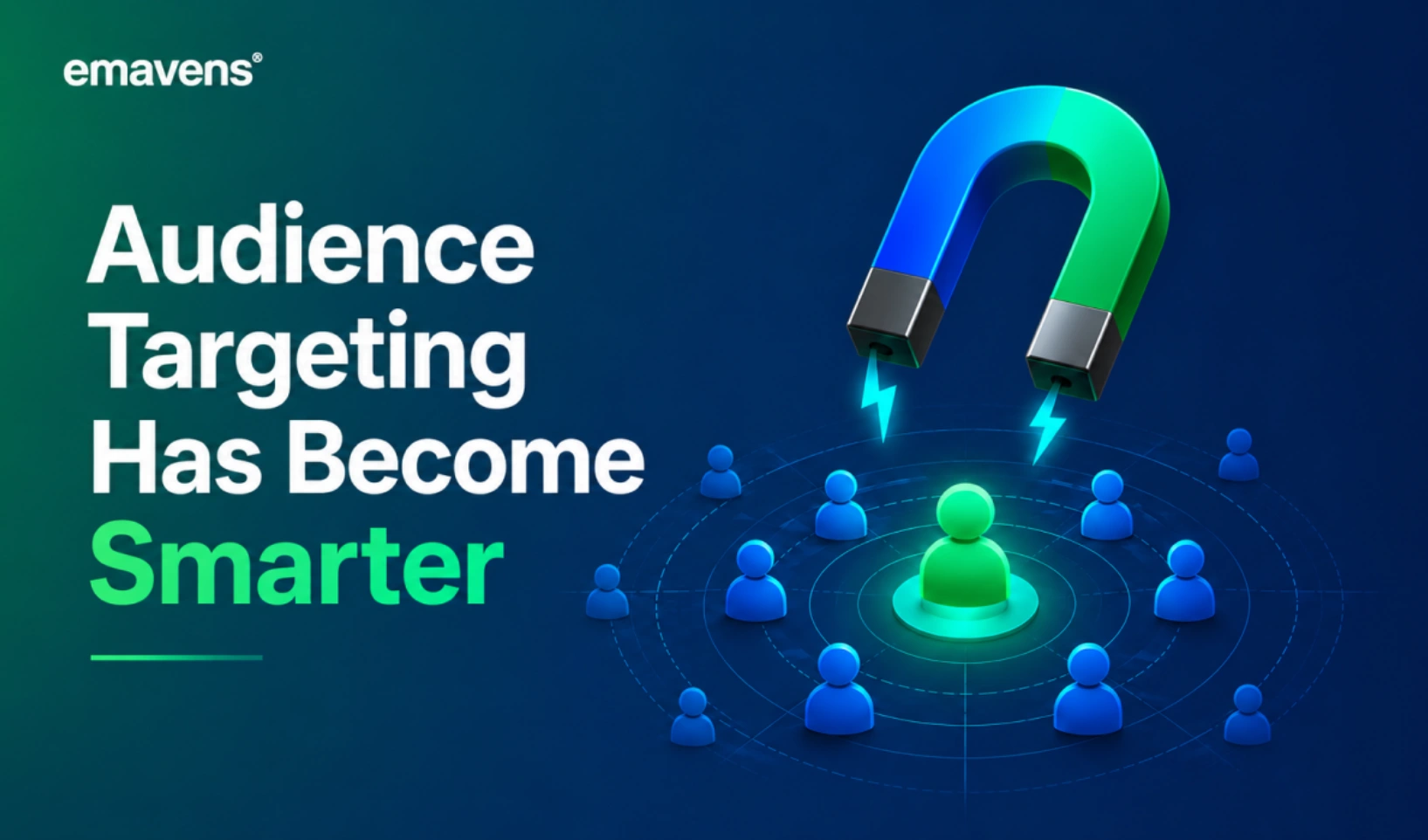
AI finds the right audience, predicts intent, and boosts conversions.
AI has transformed audience targeting from broad demographic selection into predictive, behaviour-based targeting. Instead of relying only on age, location, interests, or manually created audience segments, AI analyses browsing behaviour, purchase history, engagement patterns, and conversion signals to identify users most likely to take action.
Predictive Audience Identification AI can identify high-value customer patterns and automatically expand targeting toward users who show similar behaviours. This helps marketers reach potential customers who may not fit traditional audience definitions but have a strong likelihood of converting.
Dynamic Audience Expansion Modern advertising platforms can continuously test and expand audiences based on real-time performance. As new conversion data comes in, AI adjusts who should be targeted, helping campaigns reach more relevant users while reducing wasted ad spend.
Personalised Targeting at Scale AI also enables marketers to deliver different messages to different audience segments based on their intent and behaviour. A first-time visitor may see an awareness-focused ad, while a returning customer can receive a product-focused or promotional message.
Key Takeaway
AI makes audience targeting more dynamic, predictive, and conversion-focused, allowing marketers to move beyond basic demographics and reach users based on what they are most likely to do next.
No. AI in performance marketing replaces repetitive execution — bid edits, budget shuffles, creative variant generation — not judgement. Media buyers move up the stack into account strategy, offer design, measurement quality and creative direction, which is where most of the remaining upside sits.
It can be, but it needs signal. Smart bidding models typically stabilise after roughly 30–50 conversions in a 30-day window. Below that, use broader conversion events (add-to-cart, qualified lead) or start with a maximise-clicks phase before switching to a target CPA or ROAS goal.
Expect a 7–14 day learning phase per campaign, with meaningful performance reads at 30 days and reliable ones at 60. Resist editing bids or budgets mid-learning — every significant change restarts the model’s calibration.
Clean, deduplicated conversion tracking, server-side events where possible, accurate value data (real margin, not just revenue) and consistent naming conventions. Automated bidding amplifies whatever signal you give it — including bad signal.